My morning started with a brisk walk over to Santa Sabina College to the convent to meet the sisters for morning tea and join in their meditation community. I received quite the ego boost as I came to discover that my upcoming visit had made it into their monthly newsletter and all who were able were sitting in the common room, waiting to meet "the American." Soon after, I found myself sitting with them in the convent chapel and was instructed to meditate on the word "maranatha," which translates "Come, Lord Jesus." In this brief half hour, I realized this was the first uninterrupted chunk of time I spent simply quietly sitting, without thinking of my event-packed week, arranging flights to Auki, or getting in touch with family and friends back home, and it provided a much-needed moment of peace.
Following meditation, I met with Sr Patricia about the No Interest Loans Scheme that a handful of the sisters run in the NSW Strathfield area. This program loans out money to purchase essential household goods such as washing machines, televisions, refrigerators, computers, and furniture that low-income members of the community would not be able to purchase otherwise. The NILS program grants up to $1000, depending on the goods to be purchased, and gives the borrower 12-18 months to repay the loan without charging interest. Not widely publicized and run through an office space only 1-2 days a week, the NILS program relies on word-of-mouth to reach the target population that would benefit from this social justice service. Patricia said that the program itself showed a lot of promise- during the summer months, they averaged processing about 2 loans a week- however, their man-power may be suffering due to volunteers growing older, which threatens the long-term success of the program. However, they are inspired by the joy that the community members express after receiving a loan- many cry, hug or kiss the NILS volunteers and there is a good return rate of borrowers applying for additional loans (one mother is just finishing paying her 5th loan through NILS!). Despite the hardships faced due to the economy, members of the community are still able to find hope through one of the many social justice programs run by the Dominican sisters here in Sydney.
This afternoon Sr Rose Mary and I traveled back into the city to St Vincent's Hospital to check in on Nancy Rukia. Through talking more with her today, I came to find out that she is a 4th year medical student from Malaita who was diagnosed with muscle cancer early this year. She has spent 7 months in Sydney, being treated through surgery, chemo, and radiation, and in the past four weeks has made amazing progress. In fact, she received news that she will be discharged from the hospital ward tomorrow and will return for daily check-ups and treatment. She was extremely cheered by the promise of going beyond the walls of the hospital and exploring a bit of Sydney. Sr Rose Mary wanted to give me the chance to sit down alone with Nancy and have her teach me a little bit more about the Solomon Islands, which she hoped would give her a sense of usefulness after spending these long months alone in the hospital. In addition to giving me some pointers ("It's going to be hot! None of this winter stuff!" she said), teaching me a few necessary Pijin words, she then started asking me, in amazement, of the world of New York City. She was completely fascinated with the idea of snow, incredulous when I told her of Ridgefield's 9 snow days this past year and wanted to know how ski chairlifts worked after seeing them in the movies. As I've learned in my public service courses, this relationship building through communication is a two-way learning street and I saw it happen when I saw the smiles across both our faces as I left this evening.
Tuesday, July 12, 2011

Monday, July 11, 2011
"People who make music together cannot be enemies"
This afternoon I joined Sr Rose Mary for a lecture at University of Sydney and had a chance to tour the campus before it started. Turning off of the sidewalk and through the iron gates, I felt like I had stepped into one of J.K. Rowling's novels! Founded in 1850, it is the oldest university in Australia and is absolutely beautiful:
 |
| Hogwarts? Nope- University of Sydney! |
 |
| Foundation and walls built primarily of sandstone |
 |
| Standing underneath a bridge dedicated to fallen Australian soldiers of WWII |
Walking into their Center for Peace and Conflict Studies, I noticed countless inspirational posters supporting global peace movements that framed a wall-sized copy of the Universal Declaration of Human Rights. Here, I was introduced to the Musicians without Borders director, Laura Hassler, who was visiting University of Sydney to give a talk about her organization's international work. MwB is a global network organization that uses the power of music to connect communities, bridge divisions caused by stereotypes, and heal wounds of war and conflict. The projects developed by the organization are designed to become self-sustaining and partner local musicians with matching organizations so that they can respond to a variety of local needs. One of these projects, "The Music Bus," is a mobile center bringing music instruction to children from all ethnic backgrounds in the war-torn Srebrenica region of Bosnia and Herzegovina. By traveling into these two communities, the Music Bus crew first builds trusting relationships with these families in the area before bringing together people within each community, previously in conflict with each other. Another project, the Mitrovica Rock School, restores rock music culture to the ethnically divided city of Mitrovica, Kosovo by uniting teen Serb and Albanian musicians. Although the musicians come from very different backgrounds, they come together to form rock bands, and lasting friendships, in a week-long music camp. The program breaks through the traditional ethnic labeling and instead finds its power in focusing on the thing that each student shares- their love for music. MwB also gives attention to women who are suffering for a number of different reasons. In the refugee camps in the Srebrenica region of Bosnia and Herzegovina, Dutch and Bosnian women bring the gift of song and dance to the mothers, wives, and sisters who have lost loved ones in the Bosnian War. Laura sees this program as a type of therapy for the women, working with 'emotional language' and connecting women and building trust through empathy. All these projects seek to begin the peace and reconciliation process not on a large, governmental scale, but rather start within the homes by focusing on the women and children, which is the easiest way to bring about change within a community. Music, she says, has amazing power because it can help reconnect you with your body and is a universal language of joy; it has so much potential in bringing a person back to their spirituality after years of sadness and depression. I was reminded of a saying my great-uncle Arthur, a priest in NYC, that: "He who sings, prays twice," and only last week I saw this power of song in Nancy's smiling face, as we marched and sang down the hospital hallway. Sr Rose Mary told me this is a good introduction to the way in which I will experience how the Solomon Island people celebrate and connect with one another using music and I can't wait to see this for myself.
 |
| Hats off to Sarah who had a delicious chicken paella waiting when I returned home. Yum! |
Sunday, July 10, 2011
A Windy Skywalk and Trees That Talk
It seems as though every time I finally get caught up with my thoughts and am able to sit down and write about my day's adventures, I'm up and running with the next one! This weekend was my big sightseeing weekend and my host family made sure I saw all of Sydney- from every angle! Elizabeth, Rachel, Sarah and I made our way into the city on Saturday morning for the impressive city "skywalk" at Sydney tower for a birds-eye view of the city. It wasn't until we were strapped into our harnesses that our tour guide asked if we were scared of heights- this was not for the faint of heart! Sydney tower is the largest freestanding building in the city, over 80 stories tall and from the observation deck, you can see miles and miles in every direction. As we donned our sexy blue "smurf" suits that would help with the wind, our tour guide told us about the famous Sydney Tower "run-up," where runners raced up the 1,504 stairs to the top (record: 6 minutes and 52 seconds, which is 3 steps every second...the whole way up! whew!). Once strapping our harnesses to the track, he lead us out onto the starting platform, asking "Are you ready for your jump?!...Er, I mean tour?" scaring a few members of our group in the process. As I walked out onto the clear glass platform, I could see all of Sydney both under my feet and expanding out for miles before me. It was absolutely breathtaking!
 Our tour guide gave me a little bit more of a historic background behind Sydney Harbor, as most of my knowledge was based on a lovely little film called "Finding Nemo." Little known fact: Sydney Harbor is actually the name of a harbor in Canada- the official name of the one here is Port Jackson. Leaning over the railing, we shouted down into the streets, hearing our echo bounce back and confusing the pedestrians below us!
After sadly handing back our fashionable jumpsuits, we continued to make our way towards the harbor to get a closer view of Sydney's iconic sights.

 |
| Sarah, Rachel and me with the Harbor Bridge and Sydney Opera House behind us |
 |
| Harbor Bridge |
 |
| The Sydney Opera House is called the "copera" house by the Solomon Island people, after the coconut shells that it looks like. It's also self-cleaning; the building material is washed every time it rains. Not a bad deal. |
 |
| Didgeridoo player |
My host family took me out for an amazing dinner in a revolving restaurant that looked out over the city, now lit up for the evening. We were even surprised with a firework show set off in Darling Harbor, supposedly a weekly event, but even more special this week for marking South Sudan's independence.
 Rachel and Sarah took me out for the rest of the evening, showing me the city nightlife in true local fashion. I met 'heaps' of their friends (as they would say) and was educated in the rules of rugby while watching an Australian Rugby League (ARL) match.
Now those of you who are expecting me to return with an Aussie accent will be sorely disappointed, because besides the occasional 'G'day mate' or 'No worries,' I've managed to stick out with my very American speech. Much like the different regions in the U.S., there are also slight variations in speech in Australia, depending on where you've grown up. Speaking with the Aboriginal women last week, I can detect more of an outback drawl, while others have more of a British sounding speech. No matter how many times I've attempted it, I can't seem to make it sound authentic. Yesterday during morning mass, however, as we were reciting the Our Father aloud together, I subconsciously found myself dropping r's and softening a's- mimicking everyone's Australian accent!
The girls and I went into the city again on Sunday to explore Sydney's chinatown and to experience the traditional Chinese 'yum cha' lunch. Yum cha literally is translated as "drinking tea" and the meal is quick, chaotic and fun! Elizabeth described it as "eating heaps of food, served by fast-talking Chinese servers in a short amount of time!" Servers push around carts of food which you can select as they pass by to share for the table. They move fast and the hungry diners waiting in line after you want you to move even faster! I tried a little bit of everything: spring rolls, fried pork balls, prawn pockets, pork dumplings, rice noodles, sweet pork buns (my new favorite!) and of course cups and cups of tea.
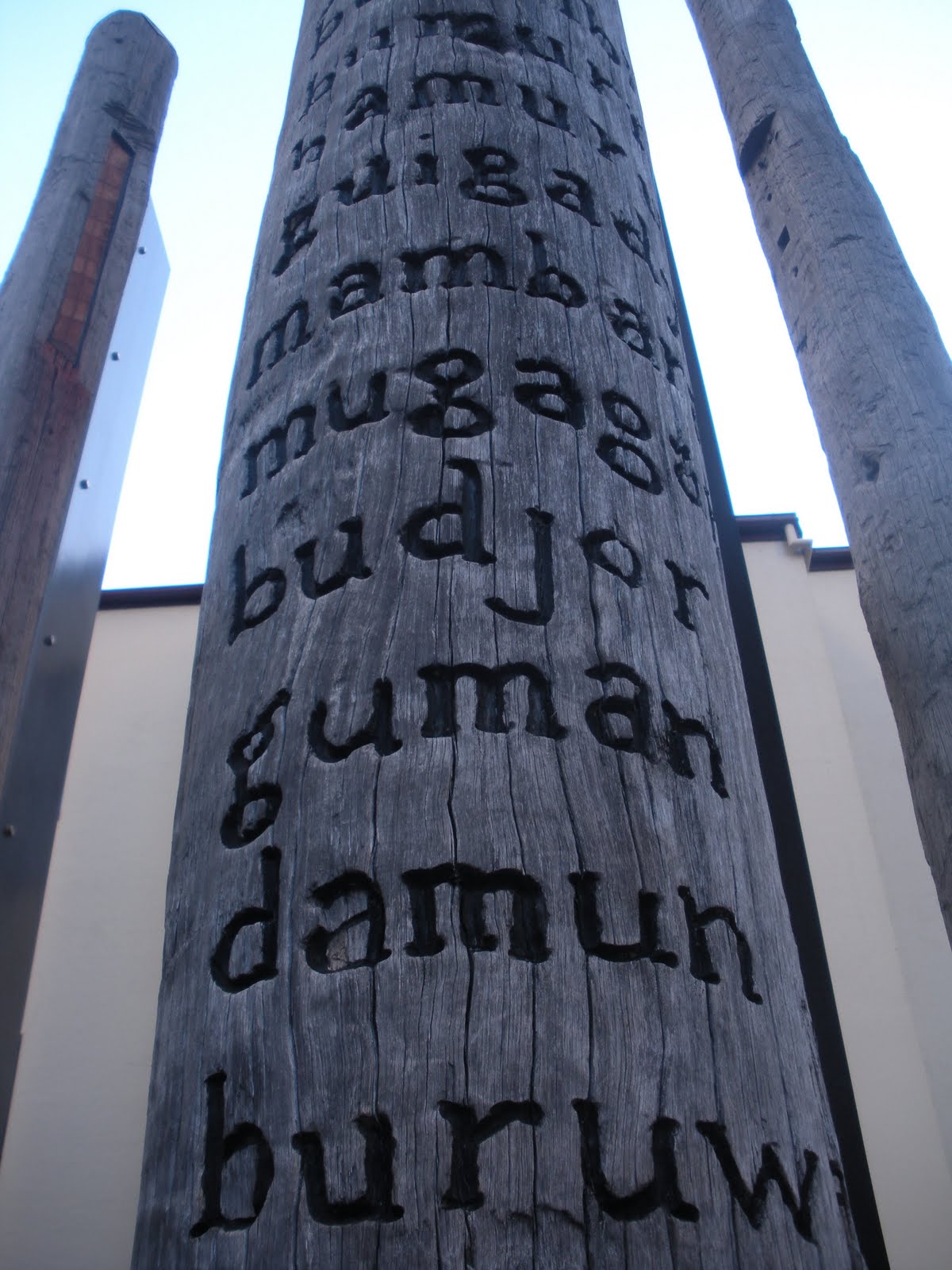
 To recover from our food coma, we took a walk to the Sydney Museum to see the new exhibit honoring of "Trees that Talk," honoring the Aboriginal culture. Outside of the building were wooden tree trunks, each carved with Aboriginal words and fitted with speakers so that it sounded like they were singing traditional Aboriginal music. Once inside, I toured exhibits about Sydney's beginnings and was interested to find just how closely its formation, growth and expansion followed the general pattern of America's beginning.
I finished off the evening by going to watch Sarah's water polo match for her university club. After all the walking and sightseeing the past few days, I was exhausted just watching the match!
As I'm writing this, it's already been a week since I've arrived and the people I've met and my experiences with them have been incredible! Another busy week coming up- I'll keep you posted!

Now those of you who are expecting me to return with an Aussie accent will be sorely disappointed, because besides the occasional 'G'day mate' or 'No worries,' I've managed to stick out with my very American speech. Much like the different regions in the U.S., there are also slight variations in speech in Australia, depending on where you've grown up. Speaking with the Aboriginal women last week, I can detect more of an outback drawl, while others have more of a British sounding speech. No matter how many times I've attempted it, I can't seem to make it sound authentic. Yesterday during morning mass, however, as we were reciting the Our Father aloud together, I subconsciously found myself dropping r's and softening a's- mimicking everyone's Australian accent!
The girls and I went into the city again on Sunday to explore Sydney's chinatown and to experience the traditional Chinese 'yum cha' lunch. Yum cha literally is translated as "drinking tea" and the meal is quick, chaotic and fun! Elizabeth described it as "eating heaps of food, served by fast-talking Chinese servers in a short amount of time!" Servers push around carts of food which you can select as they pass by to share for the table. They move fast and the hungry diners waiting in line after you want you to move even faster! I tried a little bit of everything: spring rolls, fried pork balls, prawn pockets, pork dumplings, rice noodles, sweet pork buns (my new favorite!) and of course cups and cups of tea.
I finished off the evening by going to watch Sarah's water polo match for her university club. After all the walking and sightseeing the past few days, I was exhausted just watching the match!
As I'm writing this, it's already been a week since I've arrived and the people I've met and my experiences with them have been incredible! Another busy week coming up- I'll keep you posted!
Friday, July 8, 2011
Vegemite and Turkish Tea
The breakfast menu yesterday morning included toast with peanut butter and vegemite, and daring to start off the day being a bit adventurous, I went in for a thick vegemite spread. Note to self: it does NOT taste as delicious as it looks. Mentally, I was prepared for the thick, chocolate-y hazelnut spread taste of Nutella, its close look-alike, but ended up with a soy sauce-tasting mouthful. That's not to say Rachel didn't give me fair warning, but having tried it on my previous trip to New Zealand 10 years ago, I thought I would be more than prepared. It seems as though my taste buds have forgotten just how bitter it actually is. Really the taste wasn't all that bad, it just takes some getting used to. I can't say I loved it, either, and I don't understand the obsession and the need for travel-size pouches of vegemite to snack on that I've seen while taking the trains into the city. Not quite the portable go-gurt I've grown up with...
Sr Rose Mary, Elizabeth, Rachel and I took the train into the city to continue the NAIDOC week celebrations. The city library was screening historical dramatizations and opened this Aboriginal film festival to the public. Although the purpose of this week is to celebrate the accomplishments of the Aboriginal people, these films showed a darker angle of the Aboriginal past- the initial injustices imposed by European settlers around the 1840s, including seizure of tribal land, and later on the abuses to their freedom, basic human rights and dignity as mixed-race children were separated from their mothers and taken away to missionaries and schools. Many of the problems faced by the Aborigines mirror the challenges faced by the Native Americans in the settlement of the western United States. I find it interesting to see Australia come together for an entire week to honor and celebrate this unique culture within the country- signs of it are everywhere, including hanging flags from every lamppost in the city!
On the way to the library, I got a partial tour of the city, including the beautiful cathedral at St. Marys.


After the films, Sr Rose Mary, Rachel and I went to make a visit to St. Vincent Hospital to visit Nancy, a Solomon Island patient, who is being treated in Sydney for cancer. Because the hospital care in the islands cannot provide the care she needs, Nancy has been flown over to Sydney to get her treatment. Sr Rose Mary has described the difficulties and precious time Nancy spent getting the appropriate visa and passport to allow her into Australia, something which I had taken for granted in my own preparations for travel. We happened to be visiting on July 7th, the Solomon Islands independence day, and brought a bit of a care package. While Nancy was out of her room in physical therapy, Sr Rose Mary, Rachel and I decorated it with a huge Solomon Island flag and made her favorite comfort food of rice and Solomon Island tuna (much darker than what is available in Sydney). Sr Rose Mary then proceeded to teach Rachel and me the Solomon Island national anthem so we could perform it for Nancy, though anyone who knows my singing abilities realizes that this could be considered more of a punishment for anyone listening... However, at the end of Nancy's PT appointment, we marched down the hallway back to her room, Rachel and I behind her carrying the flag and all of us singing:
Whether it was due to embarrassment from being followed down a public hallway by the world's worst singer or because she was being visited by friends who shared her love for her homeland (I prefer to think the latter), Nancy was beaming the whole way back to her room. I could sympathize with her celebrating her independence day away from home, having landed in Australia myself on the 4th of July, and not partaking in the annual fireworks and family picnics. I hope this goofy show was able to make her feel a little less homesick. She and a visiting doctor, Annalyse Crane, were able to give me advice for visiting the Solomon Islands and I am hoping to visit her again next week to continue with my lessons.


Sr Rose Mary, Elizabeth, Rachel and I took the train into the city to continue the NAIDOC week celebrations. The city library was screening historical dramatizations and opened this Aboriginal film festival to the public. Although the purpose of this week is to celebrate the accomplishments of the Aboriginal people, these films showed a darker angle of the Aboriginal past- the initial injustices imposed by European settlers around the 1840s, including seizure of tribal land, and later on the abuses to their freedom, basic human rights and dignity as mixed-race children were separated from their mothers and taken away to missionaries and schools. Many of the problems faced by the Aborigines mirror the challenges faced by the Native Americans in the settlement of the western United States. I find it interesting to see Australia come together for an entire week to honor and celebrate this unique culture within the country- signs of it are everywhere, including hanging flags from every lamppost in the city!
On the way to the library, I got a partial tour of the city, including the beautiful cathedral at St. Marys.


 |
| New South Whales Parliment House |
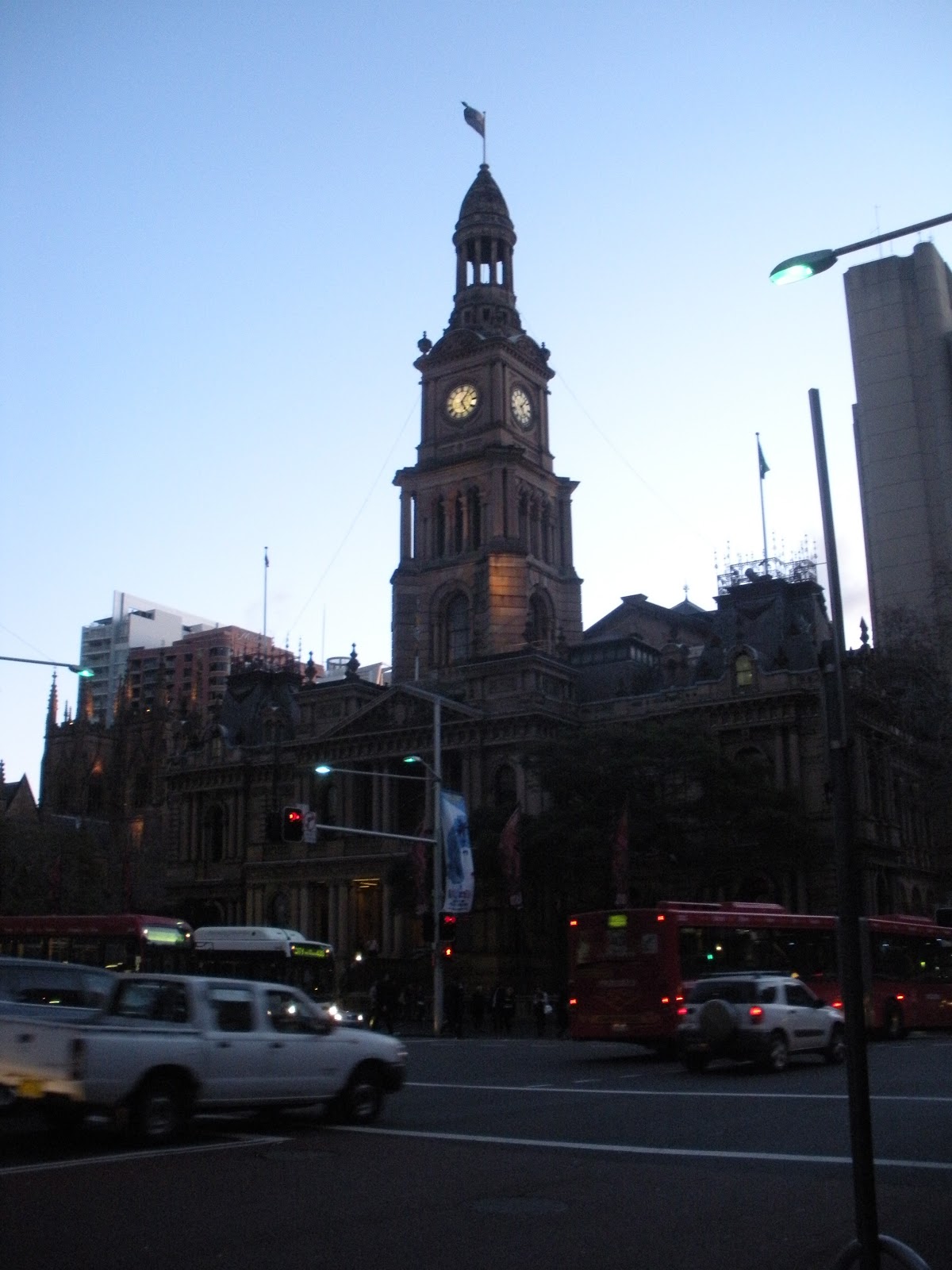 |
| City Council Building |
"God bless our Solomon Islands
from shore to shore.
Bless all our people and all our lands
with your protecting hands.
Joy, peace, progress, and prosperity-
that men shall brothers be,
make nations see,
our Solomon Islands,
our Solomon Islands,
our nation Solomon Islands
stands forever more."
 |
| Me, Nancy, Rachel, and Sr Rose Mary |
After our visit, Rachel continued my tour of the city's nightlife and we walked around the main shopping center before meeting friends for a Spanish dinner and dessert in a delicious chocolatier. Mmm mmm. I warmed up with a coconut hot chocolate- with the wind in the city it is beginning to get much colder and a more shocking transition from Connecticut summer weather than I was expecting.
Today was another jam-packed day- this time with a different focus of Dominican involvement in social justice issues. I met Sr Trish Madigan who runs the Centre for Interfaith Ministry, Education and Research (CIMER) in Sydney and who just returned from a 4 week stay in Northern Iraq. There, she was studying the different stages of female education through three generations of women and also oversaw the building of a new, private university for men in Halabja. I tagged along with her today and we made our way to the Australian Catholic University campus for a conference on global social justice issues. In addition to Trish's presentation on the importance of interfaith dialogue, other organization leaders spoke about higher education programs for Burmese refugees, combining faith and ecology to look at sustainability, biodiversity and climate change, and the problems of cyber bullying. Breaking into smaller discussion groups, Trish's discussion focused on the education of students in interfaith studies, promoting immersion programs, especially with Jewish, Muslim, and Christian students. She encourages these schools to see students of different religious background not as a challenge, but rather use them as a resource to broaden the curriculum and bring awareness to the rest of the student body. This was a great opportunity to see the real-life application of an entire theology lecture that I sat in on just a few short months ago in DWC!
Making our way back to the train, we stopped into the museum and the tomb of Mary MacKillop, Australia's first saint who was just recently canonized in October 2010. This woman was made famous for her commitment to education for the poor of Australia and even went as far as to defy orders from the local bishop who looked to control her and the sisters of St. Joseph. Despite being briefly excommunicated by Bishop Shields because of a rumor of a drinking problem, Mary is now the only Australian saint and is therefore widely revered by its citizens.
We continued on our excursion, crossing the Harbor Bridge and passing Sydney Opera House on the way back out of the city. We headed to the Auburn Gallipoli Mosque, where Trish wanted to complete my 'interfaith culture' day. The Gallipoli Mosque is fashioned after the Hagia Sophia in Istanbul, Turkey, and I recognized similar decorations covering the walls and ceiling inside.
 |
| Unlike in Turkey, where you can hear the call to prayer over the loudspeakers from the minarets 5 times a day, Sydney has limited the loudspeakers from projecting outside of the mosque itself. |


 |
| Look Ma! No shoes! Everyone is required to go barefoot while in the mosque. |
 |
| Traditionally, the men pray on the ground floor, while the women participate in the service upstairs. |

 |
| Misbaha beads contain 99 beads that help keep count as the prayer goes through the 99 names of Allah. |

Leaving the mosque, we ran into one of the mosque's singers who was coming to evening prayers. After introducing myself as an American student, we had a long conversation about American views of Islam and talked about extremists, stereotypes created by the media, and the beliefs of the majority of the Muslim population. It was such an awesome perspective to get from someone of Turkish AND Australian background; I could see he felt it was important that he promoted a positive view of Islam, in contrast to much of what the media presented. Trish then took me to meet Ahmet Keskin, co-founder of the Affinity Intercultural Foundation, which took off after September 11th and the Australian Muslims saw the need for the greater society to increase awareness of the Muslim community. It's main goal is to increase positive dialogue so that people can come to know each other and understand each other in the other's frame of reference and break down stereotypes. Much like Trish's presentation and discussion group, Affinity also focuses on youth interfaith education, from elementary to the university level, organizing over 150 events each year for the NSW community. Ahmet was very down to earth, friendly and easy to talk to, and much like the man we met at the mosque, wanted to help shed a positive light on Islam. He directed us to a Turkish restaurant nearby, where Trish and I shared delicious naan bread, hummus, maua kebab, mauti with a yogurt sauce and spices, and sweet apple tea. With my stomach still unbelievably full and many of today's conversations crammed in my head, I have a lot to digest after today's outing!
Wednesday, July 6, 2011
Spoons are for stirring
Yesterday morning I hit the ground running by meeting with Sr Rose Mary at the Las Casas Centre for Justice, Peace, and Care of Creation, housed on the grounds of the Santa Sabina college. The center was named after a Spanish Dominican bishop, Bartolome Las Casas, who migrated to the West Indies in 1502 and befriended and defended many of the indigenous people after seeing how they were massacred and exploited by conquistadores. He committed himself to working to gain full human rights for the Indian people. The JPCC's mission is inspired by his work and Sr Rose Mary works in a variety of social justice programs in and around Sydney.
 The day's agenda began with a tour around the grounds and the archives of the center by Sr Elizabeth Hellwig, the center's first archivist. She has arranged for all the historical photos, documents and artifacts of the Dominican heritage to be displayed for Santa Sabina students, as well as tourists and members of the city. Not only does she have an eye for decoration and display, but also is an amazing storyteller! I got the entire history of the family tree- and yes, a literal tree! Santa Sabina college is home to the oldest fruit tree in Australia. An orange sapling from an orange tree at Santa Sabina in Rome (where it is believed to have been planted by Saint Dominic himself in the thirteenth century) was brought to the college to symbolize the Dominican heritage stemming from Europe. The oranges themselves are a bitter and little funny looking ("That tends to happen when you get to be that old!" Sr Rose Mary joked), but make for delicious marmalade!
The Dominican sisters in New South Whales are descended from 8 sisters from Kingstown, Ireland who were called to educate the members of the community in Maitland, NSW. These young women, in their late teens and early twenties, spent 3 months traveling at sea, finally arriving in September 1867. Sr Elizabeth told about the daily hardships of the journey- cockroaches, storms and seasickness, and how they bravely pushed through with the inspiring motto: "Up she gets, for up she must!" As the center's archivist, Sr Elizabeth has translated and compiled the ship diaries of these women (I even got to see the originals!) and published them for the public.
 Another artifact Sr Elizabeth had on display: a "clapper." Once schools had been established in NSW, the sisters used these noisemakers to get the attention of their students by signaling for quiet. Reminds me a little of the Von Trapp family whistle calls...
Next Sr Elizabeth pulled out of the artifact a wooden spoon. A wooden spoon? Story has it that Saint Dominic, returning from a visit to Spain, brought back a spoon for each of the Dominican sisters of the West Indies. They were intended as personal gifts, rather than a gift for the whole community that the sisters served, giving them a bit of recognition and thanks for their work. The spoon itself represented the fact that Dominicans were supposed to be the "stirrers" working for change, but also manifested this in the simple, ordinary object of a spoon.

This idea of change is a central theme for the JPCC and it is deeply committed to other programs that support social change as well. This week, Australia celebrates NAIDOC week, or National Aborigines and Islanders Day Observance Committee week. This is a time dedicated to celebrating the history, culture, and achievements of Aboriginal and Torres Straight Islander peoples. The main theme for the week is "Change: the next step is ours," where members of the Aboriginal community can reflect on where they have come from and where we want to go from here. Sr Rose Mary gave me the incredible opportunity today to meet with the members of the Aboriginal Women Catholic Ministry who run a support center for Aboriginal people where they will feel welcomed and specifically focuses on providing social support for young mothers.

As part of the meeting, I got to participate in a traditional Aboriginal mass celebration, surrounded by Aboriginal artwork and the priest wearing an Aboriginal-inspired stole. It was decorated with crosses made up of concentric circles, which are holy symbols to the Aborigines. Fr Eugene spoke about transitioning from being 'victims' to being 'victors,' though in order to do this, we must rely on both the support from God and those in the community around us. Lunch followed soon after mass, and as I walked into the kitchen, there was Sr Francis stirring a delicious homemade pumpkin soup- with a wooden spoon. Funny how things work like that...
 I spent lunch talking with Jenny Ebsworth, one of the Aboriginal women and of the Murawari tribe. She shared her amazing stories of perseverance and her ability to serve others, even while facing hardships. The Aboriginal population still faces many challenges posed by the government, yet Jenny has been involved in the community as a volunteer for the past 6 years. By doing this, she said this makes her feel useful and that she is able to give something back to the community. She is most proud of her family and dedicates significant time and effort in raising her 6-year old granddaughter, Deykota.
On the way back, Sr Rose Mary and I compared the difficulties the Aboriginal peoples are facing with the Australian government with how the relationship and communication between American Native Americans and the U.S. government has evolved and how dialogue is a necessary aspect to improving the lives of the Indigenous peoples. This was a continuation of a long discussion yesterday about building relationships and a sense of community with all members of the global community. She and a few others from the JPCC attended a conference in Indonesia last July, which focused on challenging the unjust political, economic, social, cultural and religious structures that deprive people of their human rights and dignity. I especially liked the statement she made that "solidarity must become global." While technology is reaching across the world, recognizing and respecting each and every person must also be an increasing movement too.
...Off to watch the third and final 'State of Origin' rugby league game- an intense rivalry between New South Whales and Queensland. Everyone is rooting for the NSW underdogs...we'll keep our fingers crossed!
One of the beautiful main buildings of Santa Sabina College:
 |
 The day's agenda began with a tour around the grounds and the archives of the center by Sr Elizabeth Hellwig, the center's first archivist. She has arranged for all the historical photos, documents and artifacts of the Dominican heritage to be displayed for Santa Sabina students, as well as tourists and members of the city. Not only does she have an eye for decoration and display, but also is an amazing storyteller! I got the entire history of the family tree- and yes, a literal tree! Santa Sabina college is home to the oldest fruit tree in Australia. An orange sapling from an orange tree at Santa Sabina in Rome (where it is believed to have been planted by Saint Dominic himself in the thirteenth century) was brought to the college to symbolize the Dominican heritage stemming from Europe. The oranges themselves are a bitter and little funny looking ("That tends to happen when you get to be that old!" Sr Rose Mary joked), but make for delicious marmalade!
The Dominican sisters in New South Whales are descended from 8 sisters from Kingstown, Ireland who were called to educate the members of the community in Maitland, NSW. These young women, in their late teens and early twenties, spent 3 months traveling at sea, finally arriving in September 1867. Sr Elizabeth told about the daily hardships of the journey- cockroaches, storms and seasickness, and how they bravely pushed through with the inspiring motto: "Up she gets, for up she must!" As the center's archivist, Sr Elizabeth has translated and compiled the ship diaries of these women (I even got to see the originals!) and published them for the public.

Next Sr Elizabeth pulled out of the artifact a wooden spoon. A wooden spoon? Story has it that Saint Dominic, returning from a visit to Spain, brought back a spoon for each of the Dominican sisters of the West Indies. They were intended as personal gifts, rather than a gift for the whole community that the sisters served, giving them a bit of recognition and thanks for their work. The spoon itself represented the fact that Dominicans were supposed to be the "stirrers" working for change, but also manifested this in the simple, ordinary object of a spoon.

This idea of change is a central theme for the JPCC and it is deeply committed to other programs that support social change as well. This week, Australia celebrates NAIDOC week, or National Aborigines and Islanders Day Observance Committee week. This is a time dedicated to celebrating the history, culture, and achievements of Aboriginal and Torres Straight Islander peoples. The main theme for the week is "Change: the next step is ours," where members of the Aboriginal community can reflect on where they have come from and where we want to go from here. Sr Rose Mary gave me the incredible opportunity today to meet with the members of the Aboriginal Women Catholic Ministry who run a support center for Aboriginal people where they will feel welcomed and specifically focuses on providing social support for young mothers.

As part of the meeting, I got to participate in a traditional Aboriginal mass celebration, surrounded by Aboriginal artwork and the priest wearing an Aboriginal-inspired stole. It was decorated with crosses made up of concentric circles, which are holy symbols to the Aborigines. Fr Eugene spoke about transitioning from being 'victims' to being 'victors,' though in order to do this, we must rely on both the support from God and those in the community around us. Lunch followed soon after mass, and as I walked into the kitchen, there was Sr Francis stirring a delicious homemade pumpkin soup- with a wooden spoon. Funny how things work like that...

 |
| The Aboriginal flag: the black represents the Aboriginal people of Australia, red symbolizes the soil, and the yellow center stands for the sun, the "giver of life." |
...Off to watch the third and final 'State of Origin' rugby league game- an intense rivalry between New South Whales and Queensland. Everyone is rooting for the NSW underdogs...we'll keep our fingers crossed!
Monday, July 4, 2011
G'day mate!
I was warmly greeted in the airport by Elizabeth Pooley and John Pow, their daughter, Rachel, who is 21, and Sr. Rose Mary, who has been my contact over the past months. Sr Rose Mary was even holding a homemade welcome sign, complete with the Dominican shield so that I would recognize her. Even though I had only seen their faces from a photo sent by email, it was one of the most welcoming sights after that long plane ride and arriving alone in another country! Back at the house I met the other two Pow girls, Sarah, who is 18 and is in her first year at uni (here, short for college) and Louise, who will be starting her senior year of high school after the school holiday. They had just finished final exams before my arrival and seem to be ready to enjoy their break. The girls were amazed at how long our summer vacations are- for the most part students get 4-6 weeks in between semesters, but breaks are also more frequent. Rachel just returned from a vacation with her friends in Bali as part of her winter break. The Pows have done quite a bit of traveling over the years- Emily, Rachel, and Sarah have all gone on class trips to South Africa, and Louise is preparing to go this year as well. (I think they will be my new travel resource before my own semester abroad in South Africa next spring!) Driving around the city, Rachel and Sarah pointed out a couple of the unis that are spread out downtown. They told me it is not nearly a common to go away to school, like it is in the states. Rather, most students commute from home to one of the unis that specializes in their major. Rachel is double majoring in social work and art and goes to the university in New South Whales, while Sarah is going for physical therapy (a bit different than what it is considered in the U.S.) and has to take the train about an hour and a half away.
After some time sitting around the kitchen table with the girls, chatting and comparing accents, school and family life, Elizabeth, Rachel, Sarah and I drove over to the beach and did the Bondi to Bronte beachwalk (which, with the addition of Australian accents, reminded me of the cliff walk in Newport!) It was great to be able to stretch my legs and get some exercise. We had lunch of fish and chips overlooking the beach and the countless surfers giving lessons. The beach also had an ice skating rink right past the boardwalk and it was a little weird seeing ice and sand literally inches from each other! Although the rink was looking a little melted (it wasn't all that chilly out- just about 60 degrees) it was decorated with banners with snowflakes, hot chocolate, and even a few fake Christmas trees here and there. Christmas in July, anyone? At points on the walk I caught myself walking on the wrong side, apparently disrupting the traffic flow! I didn't realize that walkways, too, operate like the roads- always stay to the left! (Though I'll have to remember to switch back after returning home, as there is little room for head-on traffic in the tight stairways of Feinstein...)


I'm headed to meet with Sr Rose Mary at one of the local primary schools, which houses Las Casas and where I will find out more what I will be doing during my stay! More later!
Thursday, June 30, 2011
T minus 2 days
Who would believe that after months of preparations, emailing, and flight-booking, my day of departure would finally arrive?! I'm in the packing stage now, yet no matter how ahead of schedule I thought I was, I am still seem to be scrambling to pick up that last minute bottle of bug spray, throw in that last load of laundry, and send out those last few emails. In 48 hours I will be en route to Sydney and I am so excited to begin my journey! Through reading their blogs, I have been living vicariously through the other Smith Fellows and have been amazed by their unique, yet each enlightening, adventures.
As I write this, there are two piles of clothing sitting on the floor in my room -'winter' gear and summer attire. When I arrive in Sydney, it will technically be winter (though coming from the cold, wet winters of the northeast, it should feel more like spring!). However, the Solomon Islands are much more constant throughout the year, and it's expected to be more like the summer weather I will be leaving behind. The weather isn't the only difference, though. As Bishop Chris had told me earlier, the everyday lifestyle in Auki is much more laid-back than the bustling urban center of Sydney -even to the extent of closing down their main airport! I found out yesterday that the Gwanaru Airport in Auki is currently closed, which is said not to be so surprising considering how often flights going from island to island get cancelled. I'll say a prayer and keep my fingers crossed that it is back up and running by the time I leave Sydney but I've been told there is also an option to take a boat if necessary. Either way, this leg of the journey is promising to be an adventure!
As I write this, there are two piles of clothing sitting on the floor in my room -'winter' gear and summer attire. When I arrive in Sydney, it will technically be winter (though coming from the cold, wet winters of the northeast, it should feel more like spring!). However, the Solomon Islands are much more constant throughout the year, and it's expected to be more like the summer weather I will be leaving behind. The weather isn't the only difference, though. As Bishop Chris had told me earlier, the everyday lifestyle in Auki is much more laid-back than the bustling urban center of Sydney -even to the extent of closing down their main airport! I found out yesterday that the Gwanaru Airport in Auki is currently closed, which is said not to be so surprising considering how often flights going from island to island get cancelled. I'll say a prayer and keep my fingers crossed that it is back up and running by the time I leave Sydney but I've been told there is also an option to take a boat if necessary. Either way, this leg of the journey is promising to be an adventure!
Subscribe to:
Comments (Atom)