Whoever said, “less is more” apparently never consulted 4-year olds armed with finger paint and glitter! I spent the morning up to my elbows in arts and crafts materials alongside the preschoolers at the Catherine Sullivan Centre during their weekly "playgroup" time. This program takes an early-intervention approach for hearing-impaired children and their parents before they enter school. Instead of sign language, the program focuses on the auditory-verbal learning program and the kids are fitted either with hearing aids or cochlear implants to help them hear. Volunteers work with kids 6 months and up in individual therapy sessions, language groups, weekly playgroup, preschool visits, field trips and family support programs. The Catherine Sullivan Centre upholds the Dominican legacy of working with the hearing impaired; its namesake was the first student with hearing impairment to be taught by the Dominican Sisters in Australia and this type of education is still in full swing in Strathfield today.
When I first arrived, I was a little unsure of how to interact with the kids. Although I've had years of babysitting under my belt, I've never dealt with a hearing-impaired child. I wasn't sure if I would have to communicate with hand motions or sign language and if I would be able to pick it up in just one day. But in reality, these kids benefitted from amazing technology and responded like most hearing preschoolers. After getting a complete tour of the facility, I fell naturally into the arts and crafts station. There, I ended up working with Maxine, a quiet 4-year old who had positioned herself at the painting booth. During the span of 20 minutes, she demonstrated a rather interesting approach- layering. After squeezing out about 1/2 cup of paint (I wish I was exaggerating, but I have green and purple-covered arms to prove it!), she followed it by emptying a bottle of gold glitter. Deep in artistic concentration, she turned to me every few minutes so I could wipe her fingers clean of paint and confetti so she could start the process all over again. She repeated it again and again until we ran out of paint and glitter and the paper ripped under the weight and she smiled proudly at her masterpiece.
Living with a hearing impairment is normal for this Maxine and her family and today I got a brief glimpse of how members of her community try to normalize her childhood experience. Years ago, she and other hearing impaired children might not have the opportunity or technology to participate in everyday activities, but now 5 out of the 6 "graduated" members from last year's playgroup went on to enroll in regular local kindergarten classes. I think this speaks volumes of the amazing technology these children and families are benefitting from, as well as the untiring involvement and support from volunteers who have even become considered part of the families over the years.
Wednesday, July 20, 2011

Tuesday, July 19, 2011
Turn Down the Heat
I returned from Newcastle yesterday evening after being dropped off at the train station by Diana, with a farewell of "Be good...and if you can't be good, don't get caught!"
This morning the NSW schools were back in session after their mid-year holiday and I got the official tour around the Santa Sabina campus (I loved how there was no cafeteria- instead everyone ate lunch outside on the field. I guess that's another perk for having good weather year round!). Louise graciously let "the American visitor" tag along with her group of friends at lunch and I was immediately interrogated about all the American stereotypes -Jersey Shore (had to insist that it was NOT in fact a good representation of New Jersey citizens), cheerleader/jocks "classification," and a whole range of other things they wanted to know about American TV and movies. They had a good laugh quizzing me on my pronunciation of certain words- apparently 'aluminum' is is pronounced quite differently here!
After lunch I sat in on a lecture at the Edmund Rice center about Kiribati and the effects of climate change. Kiribati is the island nation that is further northeast from the Solomon Islands and because it is only 2-3 meters above sea level it is drastically suffering from the rising ocean waters. The discussion focused on the adolescent involvement in raising awareness for their troubled country and how they were taking advantage of social media, music and TV programs to reach out to the rest of the world. One of the island's local youth group campaigned with a song and music video called "Turn Down the Heat" (a bit ironic after my chilly past couple of days, and made me feel slightly guilty for being wrapped up in electric blankets!). Their goal is to raise awareness to stop global climate change so that their islands are not permanently damaged by flooding and salt water intrusion, which then affects vegetation and human health. The citizens expressed how they didn't want to become environmental refugees and instead wanted to be taken seriously by the policy makers in the UN so that quick and effective measures could be taken to protect their homeland. Heading to that region of the Pacific in a week to the Solomon Islands, I will be curious to see if there are similar concerns and efforts made towards this cause...
This morning the NSW schools were back in session after their mid-year holiday and I got the official tour around the Santa Sabina campus (I loved how there was no cafeteria- instead everyone ate lunch outside on the field. I guess that's another perk for having good weather year round!). Louise graciously let "the American visitor" tag along with her group of friends at lunch and I was immediately interrogated about all the American stereotypes -Jersey Shore (had to insist that it was NOT in fact a good representation of New Jersey citizens), cheerleader/jocks "classification," and a whole range of other things they wanted to know about American TV and movies. They had a good laugh quizzing me on my pronunciation of certain words- apparently 'aluminum' is is pronounced quite differently here!
After lunch I sat in on a lecture at the Edmund Rice center about Kiribati and the effects of climate change. Kiribati is the island nation that is further northeast from the Solomon Islands and because it is only 2-3 meters above sea level it is drastically suffering from the rising ocean waters. The discussion focused on the adolescent involvement in raising awareness for their troubled country and how they were taking advantage of social media, music and TV programs to reach out to the rest of the world. One of the island's local youth group campaigned with a song and music video called "Turn Down the Heat" (a bit ironic after my chilly past couple of days, and made me feel slightly guilty for being wrapped up in electric blankets!). Their goal is to raise awareness to stop global climate change so that their islands are not permanently damaged by flooding and salt water intrusion, which then affects vegetation and human health. The citizens expressed how they didn't want to become environmental refugees and instead wanted to be taken seriously by the policy makers in the UN so that quick and effective measures could be taken to protect their homeland. Heading to that region of the Pacific in a week to the Solomon Islands, I will be curious to see if there are similar concerns and efforts made towards this cause...
Monday, July 18, 2011
July 18th: Walking in their shoes
Today I got locked in a jail cell by a religious sister. Ok ok- it was for all of 30 seconds, yet staying true to the Australian legacy of jailing convicts, this morning Sr Diana bolted a heavy iron jail cell door closed behind me, leaving me enclosed in complete, musty darkness. We had just arrived at Penola House, the refugee support center that Diana runs, where she volunteers distributing household goods and appliances and being a resource to refugee families that have just arrived in Australia. Penola House was converted from an abandoned police station years ago and still contains a handful of cells that are used for storage and “volunteers that don’t work hard enough.” I have gotten to know Diana well enough to know she was only half-joking, and prepared myself for another busy day. Our day started even before the doors officially opened when community members began knocking on the front gate, asking for Sr Diana’s help. As Diana opened up the building, I stood in the doorway, watching as 4 women Burundi dancers claimed a room for rehearsal space and began a traditional song and dance routine.
Behind me, Diana was a whirlwind of continuous action as usual, running in and out of her office, shooting imaginary guns at the small Congolese boys playing on the blacktop and sarcastic quips at anyone who walked by. She only slowed down long enough to briefly introduce me to her two usual volunteers, Suzann and Kathy, who I would be working with. Our job today was to pack up and transport mattresses, bedding, towels, vacuum cleaner, microwave, platters, and silverware across town to a new Afghani family that had just arrived with virtually nothing.
We pulled up to the house and immediately two small faces with large, dark brown eyes that had been pressed up against the front windows, ducked out of sight. We introduced ourselves to Mustafa Syed, the oldest son of the family and who understood the most English, therefore acting as translator between his 11 other members of his extended family and us. We were shown around their new home –nearly completely empty, except for layers of overlapping rugs cushioning the floors a few throw pillows and some kitchen utensils, all borrowed from Mustafa’s uncle who had arrived in Australia a few years ago. After taking inventory, we were off to the Penola storage center to pack whatever donated items we could fit into the car and trailer and bring it back to the house. As we were unloading I noticed the two young kids, probably 4 and 5, constantly sneaking around behind me trying to get a glimpse of my French braid, pointing and whispering to each other. When they knew they were caught, they squealed, laughing, and ran away with huge smiles across their faces.
Joining Suzann and Kathy in the kitchen, now full of pots, pans, and cooking utensils, I stood by listening to them trying to explain the governmental forms that Mustafa wanted help with. The complicated immigration and Centrelink (the governmental funding agency) papers were almost impossible for me to understand listening in English, so I could only imagine the confusion that Mustafa must have felt, and then turning around to play a game of ‘telephone’ with his other family members. As I stood there shifting back and forth on my bare feet, trying to keep warm on the cold linoleum (as is the custom, we removed our shoes at the door), I felt a little tug on my leg and looked down. The little girl, who I learned was Mustafa’s younger sister, was pointing at a pair of plastic Disney princess flip flops that she had placed at my feet. I smiled, but shook my head, not wanting her to give up her own shoes, but she smiled back, energetically nodding and pointing and so I slipped them on. Once again, I have been amazed by the hospitality offered by all the people I have met on my trip. These small children, who don’t even have their own toys to play with, quietly but genuinely desired to share with others what they did have. Although they didn’t have the usual material possessions (I couldn’t help but thinking of the countless comfort items I had insisted on buying for this trip), they finally had the political safety after leaving the Afghani refugee camp and the support of one another. In just her politeness, this one little girl showed me that it's not about what you don't have -it's what you're able to give.
(Below are some posts from the past few days –only now being put up now that I have internet again)
July 17: Joy
I’ve come to the conclusion that Sr Diana very well could be the energizer bunny –she keeps going…and going…and going…
 |
| Every 10 minutes, a freight train of 50 cars leaves the coal piles to bring it to the ships at port. |
Keeping with the Dominican sisters’ habit of a full itinerary, we were up at 6:30, showered, had eaten breakfast (all the sisters constantly insist on giving me full meals, wherever I am), loaded the car and trailer, and attended mass down the street before starting the day’s activities. We first drove to see the coal port –Diana informed me that Newcastle is home to one of the world’s largest coalmines and processes an incredible amount of coal per day. The noise and smell was tremendous, and we were lucky that the wind had not picked up to blow clouds of coal dust.
 |
| Regina and Sr Diana posing for a picture |
Our next stop was the town of Cessnock to visit a family of Sudanese refugees, who have been living in a hostel there for the past two years. Diana spent the morning catching up with and introducing me to Regina, her daughter, Gloria, and Gloria’s newborn, Molly MacKillop (named for the Australian saint? Perhaps…). She helped them sort out logistical questions; because Regina is not able to read or write in English yet, Diana helps out regularly with mail and governmental forms. Together, we built a “chook” (chicken) house and yard from recycled fencing and stakes Diana and I had brought in the trailer. The family will go to the county fair in a week or two to pick out chickens to raise –although after another sleepless night, Gloria teasingly threatened to throw Molly in the pen instead. Diana recognized that gardening and farming was a central part of the Sudanese life back in Africa and wants to be able to bring them healing by giving the family the opportunity to do some here.
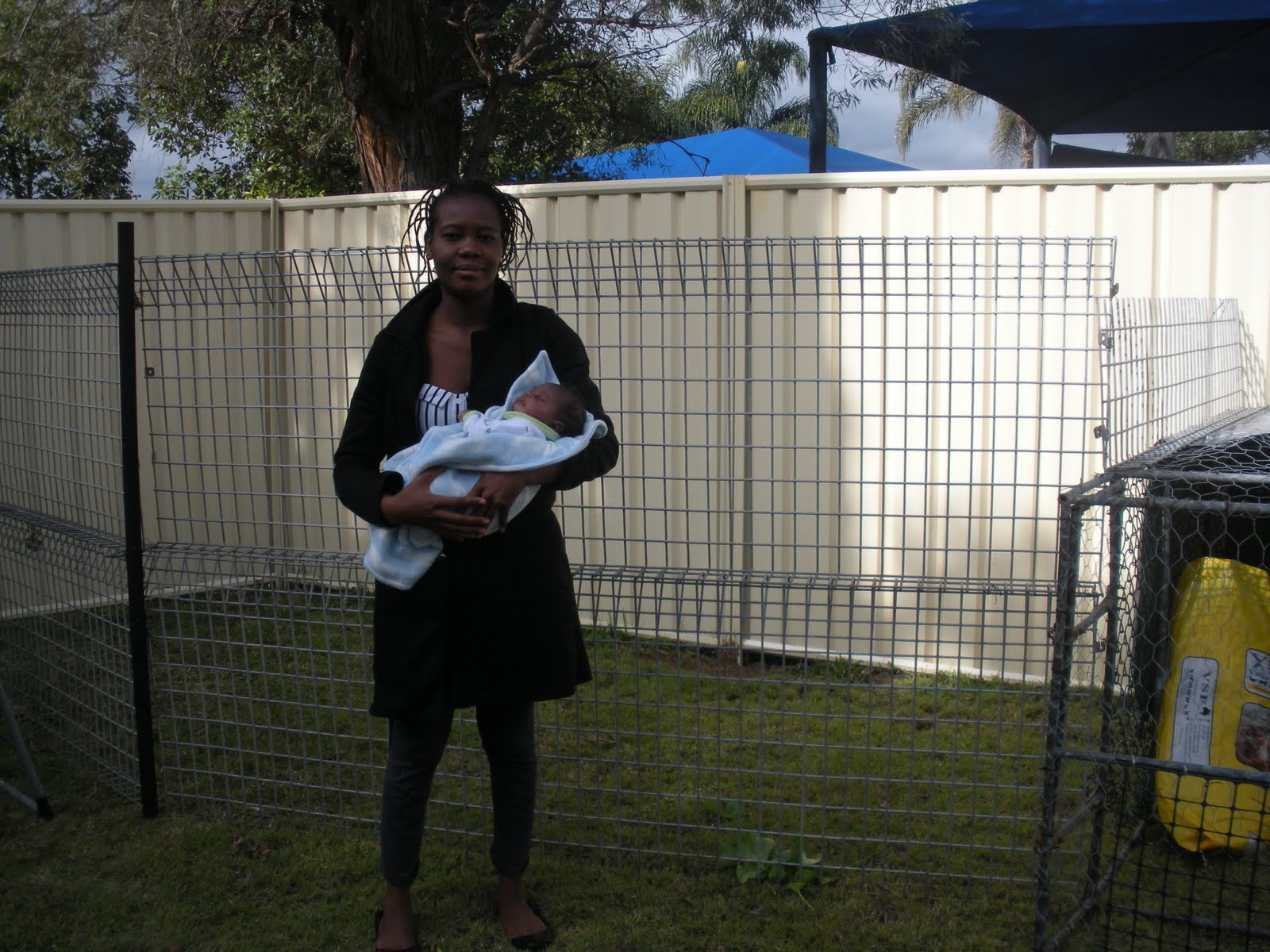 |
| Gloria and Molly proudly showing off their new chook house |
This quest for farmland lead us to our next stop at Golka, the Hare Krishna farm, where we met with the head farmer, Andre, to inquire about giving some of the Sudanese families a few plots to work with. This farm is set in the valley between mountains and had the most amazing scenery and wildlife –I even spotted a kangaroo grazing along the drive on the way into the farm!

Andre was working in his greenhouse, which was dedicated to growing “holy basil.” He plants the seedlings on days of a full moon and he explained that the Hare Krishna’s believe these plants are manifestation of one of the female deities. After walking through the garden and exploring the farm, Diana took me up to see the temple and meet Calia, who is at the head. It was my first time ever seeing a Hare Krishna worshipping community and I was a bit confused and unsure as to how to respond to the “Hare Krishna” greeting and bowing that everyone did as we passed. Calia was an older, gentle-looking man, draped in a beige robe, which looked much like a toga, a stripe of paint down his forehead and bridge of his nose and was completely shaven except for a patch of long hair on the back of his head. Like every host I have met on m travels, he graciously offered us lunch; while it was being prepared, Diana nudged me and whispered, “I come here to get fed by the best cooks!” He brought out plates of fresh vegetables from the gardens, rice, curry, flatbread, and “sweet rice” (like rice pudding) made with cream from the cows on the farm. It was absolutely delicious! Diana was even more thrilled when Calia sent us home with fresh, homemade fudge, which we broke into before even reaching the parking lot!
 |
| The temple is the most famous in Australia –Di described it as “small, yet respected” and there was a crowd of visitors from Sydney and other areas for the weekend |
After a long day on the road, Diana then took me back to the house to give me her own tour of her ‘permaculture garden.’ This house would make any environmental science teacher proud! Diana has invested in countless environmental systems, including south side facing windows to maximize sunlight to warm the house, solar panels on the roof, and rainwater collection bins. She also uses recycled water filters –I came to find out that the water for my shower this morning was being recycled through coconut fiber beds filled with worms (really?!) and then used to fill the toilet tanks and water the garden. Pretty amazing stuff.
Tonight I reflected on the people I had met today that were in various economic, social and religious situations. At the risk of sounding cliché, I came to the realization that despite these outward differences that initially put me out of my comfort zone, I found them all exuding joy and in some way they also shared this joy with others. I received warm welcomes from all of the parishioners at mass early this morning in hugs and handshakes and although separated by language, in her own way Regina was just as joyful and welcoming with her abundant smiles and plates of cookies. Gloria passed along the happiness of her newborn baby by giving her to me to hold and admire just as I saw Calia’s generosity through his quiet spirituality. Even the two sisters’ love of life was catching –Betty’s joy in her love of cooking and Diana’s energy and enthusiasm for sharing the treasures of her garden. After spending some time talking and listening –actively listening –to each of these people, it was harder to recognize the differences I originally perceived and instead I could see how each was able to express joy.
July 16th: A friendly face
Stepping off the train after the 2-hour ride to Newcastle and onto the platform, I was greeted by an energetic and smiling Sr Diana. I can’t think of a better word to describe her other than ‘feisty.’ Immediately after introduction, she grabbed my bag, hollering, “Come on, now! Let’s go! Keep up!” as we made the brisk walk to her car up a hill. I was soon to learn she was always on the move and she doesn’t plan on slowing down anytime soon. On our drive to her home, she informed me, rather matter-of-factly, “I’ll be staying around to turn out all the lights, if you know what I mean!” Diana, I came to find out, has been arrested on at least one occasion for protesting for a social justice issue early on in her career and easily gets fired up about the injustices faced by the Sudanese refugees that she works with. Even watching TV can be an intense activity –I was startled by an outburst of “Oh, you idiot!” as she addressed a rugby player who fumbled the ball on a game-winning play. Throughout the evening, she continued to surprise me, especially when discussing the ever-popular Colin Firth (“I don’t mind watching a scene or two when he’s in a damp t-shirt. What? As a sister, I’m supposed to appreciate the beauties of God’s work!”).
Diana lives with Sr Betty, who is sort of the port in a stormy sea, much more quiet and laid back and lovingly cares for the three dogs, Bella, Princess and Jack at home. (On more than one occasion, Betty has nodded at me after one of Diana’s outbursts, rolling her eyes.)
Diana, shocked that I had not yet spotted kangaroos or koalas, she carted me off then and there to the nearby wildlife reserve to make sure I got the proper Aussie experience. We parked, walked through the gates, and bam! Kangaroo sighting!
 |
| G'day mate! |


After leaving the reserve, we made a last-minute visit to John Hunter Medical Hospital to see Sr Beth Egans, who had just suffered from a stroke this morning. I am amazed by the energy, dedication and compassion that Diana shows. On our way into the hospital, Diana quoted good ol’ Forrest Gump, “What is the meaning of life? I don’t know, I just keep running.” Staying true to her word, she scoffed at the elevators full of visitors and went straight for the stairs, me jogging behind her to keep up (perhaps I’ll register her for the next Sydney Tower sprint?). Diana brought me in to meet Beth, who despite having EMT people huddled around her bed who were preparing to transport her another ward, insisting on giving me a hug and kiss, and knew who I was before I had the chance to introduce myself. I watched as Diana’s energy lit up the room, bringing joy not only to Beth but also the three other patients sharing the room. Her spark –whether fighting for her refugee families, or simply touring an American student through the bush –is incredibly inspiring.
July 15th: The Stolen Generation
After a rather chilly night spent curled up with my electric blanket and a cup of tea, I was off to meet Kerry Reed-Gilbert, coordinator of the Aboriginal people and Torres Island people resource center at ACU. Kerry is a Wiradjuri woman from central NSW, and is both an accomplished writer and businesswoman, running her own business, Kuracca Consultancy. Through this organization, she conducts training on Aboriginal culture, heritage and history, as well as advocating for human rights in her writing. I don’t know if I’ve ever met a more welcoming and generous person! Not only did she have a small “ditty bag” ready for me, full of reading material, a signed copy of her compilation of Aboriginal female writing, and a number of traditional trinkets, more importantly she shared her own story over morning “cuppa” and “bikkies” (coffee and biscuits/cookies).
Kerry began by describing her heritage. In addition to identifying themselves by their tribal names and nation of origin, Aboriginal people also adopt totems. Kerry’s personal totem is the white cockatoo, which symbolizes the messenger and she aims to fulfill this role of messenger in her writing by addressing the interests, concerns and issues that the Aboriginal people face today. Totems are chosen symbols that show how you are connected to the land and how all of nature is related to you- animals, rocks, trees, water, even the wind. This system of belonging is often referred to as “the Dreaming.” Your person is comprised of this symbolic totem and a guiding and protecting “miwi,” or justice spirit/gut feeling. She then launched into the Aboriginal creation story and how all the natural elements are connected to one another. She played me a beautiful “song of the earth” that was developed by the Wiradjuri nation of NSW:

Gundrah Ah. Lah. oo. noo
Nungeena Tya
Gundrah Ah Lah oo oonoo
Yahma Koorah Yamah
Koorah
Nungeena Tya. Yah, Ah
Mah Koo-oo-Rah
“Mother Earth
We are eternally linked
I honor you
I greet you Mother Earth”
Man learned to tell the creation story by listening to the country tell it to him and then it was his responsibility for him to share this story. It was interesting the way she explained that knowledge is not ours –instead you must always pass it off to someone else, otherwise you would be considered greedy. It was the responsibility of the “black fellas” to teach the Europeans their laws and how to the respect and watch over their country. But I found it shocking to listen to her say that despite the cruelty and suffering endured by the Aboriginal people because of European colonization it was partially their own fault for not properly teaching these European newcomers. There was no anger in her story, just the desire to fight for gaining back the sovereignty that had been stolen from them.
“The Stolen Generation” refers to the Aborginal peoples that were taken from their families by the government in order to assimilate them into European culture (there is a great depiction in the movie Australia) in the hundred-year period between the 1860s and 1960s. It wasn’t until 2008 that the Australian government offered a formal apology to the Stolen Generations.
 |
| Aboriginal tent embassy outside Parliament House |
After years of trying to cover their Aboriginal heritage, there has been an increase during the past decade to claim Aboriginal legacy and embrace the culture. Kerry told me a story about a friend who recently came to the discovery of her Aboriginal background. Adopted as a baby, she grew up not knowing this part of her identity, but began piecing together slight differences (having dark eyes while both of her parents were blue-eyed and hints in her birth certificate). Because the dark skin is no always passed down, she did not have this indicator. After confirming her Aboriginal decent, other pieces of the puzzle began to fall into place. It explained the extreme sickness she faced while on a school fieldtrip back in primary school. She had experienced severe stomach pains after crossing the ancient tribal boundary into “man’s land,” which was not allowed of Aboriginal women. These pains immediately disappeared after retreating over the boundary, but returned when she tried to rejoin her class.
Kerry’s excitement and enthusiasm for sharing her culture and heritage was infectious, and her desire for gaining social justice for the Aboriginal people and Torres Island people was inspiring. As I was leaving, she hugged me, saying “thank you for sharing the journey –may we share many more miles.” Overall, I was truly amazed by her strength and determination for fighting for the dignity of the human person and reclaiming the sense of belonging to the community that the Aboriginal peoples had been a part of for thousands of years.
After leaving Kerry I met with students at Australian National University in Canberra (if Sydney is like New York City, Canberra is the Washington D.C. of Australia). They took me on a sightseeing adventure of the city, and I witnessed all the famous sights:
 |
| New Parliment House |
 |
| Australian Coat of Arms: It includes a Kangaroo and Emu, both of which can't move backwards, therefore symbolizing a nation moving forward. (Fun fact: Australia is the only nation that eats the animal on its coat of arms!) |
 |
| Senate Chamber |
 |
| House Chamber |
 |
| Just in case the whole college thing doesn't work out...prime minister is always an option! |
 |
| Climbing Mt. Ainslie (kept an eye out for kangaroos, but no luck) |
 |
| overhead view of Parliament Triangle |
 |
| National War Memorial |

Friday, July 15, 2011
The American’s Attempt to Reinvent the Australian Healthcare System…
Late Wednesday morning, Sr Rose Mary and I were joined by Jane Sullis, another member of the JPCC, to make the 3-hour trek to Canberra (the capital of Australia- NOT Sydney, as the residents were quick to inform me!) to visit the Australian Catholic University at the Signadu campus. This was my first time venturing outside the main city of Sydney since arriving and it allowed me to see another side of Australia. As I watched the strikingly different landscape flash by my passenger window, it hit me that I was in a completely different country. Driving past farmlands and vineyards, I could see across the flat landscape for miles- something I am not used to in rocky, mountainous New England. We passed Lake George, aka the wide, flat expanse now covered with grass, shrubs, and the occasional herd of cattle due to the 10-year drought. Caution signs lined the highway warning drivers: “Wombats, next 12 km.” Not something you see while driving up I-95!
However, more shocking than the landscape were the freezing temperatures. Stepping out of the car upon arrival, I noticed frost on the ground and could see my breath in the air. Brrr! The retreat center we were staying in didn’t have central heating so I made good use of the electric blanket in my bed and the endless supply of tea.
 |
| A rather dry Lake George |
We ventured out to dinner at Zombaros, a stop-in Mexican storefront much like Chipotle. It’s a growing chain started by a local doctor based on the one-for-one business model: for every meal served, the founder donates a meal to a third-world country. (For those of you who know my obsession with TOMs shoes and this similar model, I was in full support!) I got to walk Sr Rose Mary through ordering her first (ever!) Mexican meal and greatly amused the man behind the counter by helping her order a burrito with all the fillings- go big or go home! (although we did skip the hot sauces…) I think she and Jane enjoyed this cuisine adventure, or at least they both finished their burritos!
Thursday morning (after a cheerful wake up call by a tree full of magpies outside my window) it was back to school for me- Sr Rose Mary made sure I had a hearty breakfast before dropping me off in front of the steps of ACU to meet my professor, Peter Humphries, who teaches the winter intensive course on social work and mental health for graduate students. Living in the same town all my life, I’ve never really experienced the anxious feeling of arriving as a brand new student in the middle of a semester- until today. However, in true Aussie fashion, their warm welcome made me comfortable right away. Peter put me on the spot right off the bat and asked me about an American perspective on health care organization and reform (thank goodness for my American Health Care course last year!). I was able to give a brief explanation of the individualistic and largely privatized approach to the American system; many of the students found this shocking compared to their universal health scheme, which seemed like the obvious answer to them.

During the lecture we also focused on mental health diagnosis and treatment within a social and cultural context –and in particular the implications of treating the Aboriginal population. Much of what Peter described as the physical, mental, social, and spiritual balance of Aboriginal health applies, too, to the Native American and African American approach to treatment in the U.S. Practitioners, he said, had to be able to also be able not only to recognize these cultural variances, but also be able to adjust treatment according to the “continuum of care,” depending on the severity of mental health challenges. Armed with this information, Peter broke us into groups to design the ideal Australian health care structure (“Maybe bring this back to America with you!” he joked). To judge our models, he brought in a consumer of the mental health care system, another one of his students who was diagnosed with depression, anxiety, and OCD. Narrating her personal struggle, she was able to tell us her experiences in using the mental health care services. I found her extremely brave to be able to stand in front of her peers and expose this personal experience, but as I’ve learned through these various social justice programs, most of the time it is these personal narratives that have the biggest impact for helping others understand and change.


During the lecture we also focused on mental health diagnosis and treatment within a social and cultural context –and in particular the implications of treating the Aboriginal population. Much of what Peter described as the physical, mental, social, and spiritual balance of Aboriginal health applies, too, to the Native American and African American approach to treatment in the U.S. Practitioners, he said, had to be able to also be able not only to recognize these cultural variances, but also be able to adjust treatment according to the “continuum of care,” depending on the severity of mental health challenges. Armed with this information, Peter broke us into groups to design the ideal Australian health care structure (“Maybe bring this back to America with you!” he joked). To judge our models, he brought in a consumer of the mental health care system, another one of his students who was diagnosed with depression, anxiety, and OCD. Narrating her personal struggle, she was able to tell us her experiences in using the mental health care services. I found her extremely brave to be able to stand in front of her peers and expose this personal experience, but as I’ve learned through these various social justice programs, most of the time it is these personal narratives that have the biggest impact for helping others understand and change.

Subscribe to:
Posts (Atom)